I was in Sharjah, standing next to a street cart that smelled like cardamom and deep-fried joy, eating what I swore were Luqaimat. But then the vendor said, “We call this Luqaima.” And I—mid-bite, syrup dripping onto my fingers—was like, “Hold up. Are they not the same thing?!”
That moment kicked off a full-blown snack spiral. What is the deal with Luqaima vs Luqaimat? Are they twins? Cousins? Total imposters?
If you’ve ever wondered which of these sweet Emirati dumplings really reigns supreme—or if they’re just two names for the same delicious thing—grab a cup of gahwa (or Karak, I won’t judge) and let’s go deep. Like, syrupy-deep.
PROBLEM: Too Many Names, Not Enough Clarity
We’ve all been there, right? You’re at an Emirati restaurant or food truck, the aroma of rosewater hits you, and the dessert section proudly offers Luqaima. Or maybe Luqaimat. Or sometimes both, like some kind of sugary identity crisis.
One friend tells you, “They’re the same thing, just different accents.” Another swears they’re made differently, like one’s got saffron and the other’s more doughy.
So what’s the reality?
This mess doesn’t only make life harder for foodies, it makes it harder for menus, Instagram captions, and your search history trying to recreate it at home.
And let’s not even get started on spelling. Luqaimat, Lugaimat, Logaimat, Luqaima, Loqaymat. Like… can a dumpling catch a break?
AGITATE: The Wrong Order Can Haunt You
Picture this.
You’re in Abu Dhabi. You’ve been craving that crispy-on-the-outside, gooey-on-the-inside dumpling drenched in sticky date syrup. You’ve even fasted for it. You order “Luqaima” at a trendy café and what arrives is… different.
It’s round-ish, sure. But the texture’s off. It’s less fluffy, more chewy. Still sweet—but not what your soul was whispering for.
That’s the danger of not knowing the difference. You can miss out on the experience, all because of one tiny letter swap.
Even worse? Trying to order it online. You hit up KosharyZizo.com (which, btw, has some bangin’ regional dishes and should totally be bookmarked if you love Middle Eastern food), and now you’re staring at two listings wondering: Which one’s the “real” one?
But here’s the good news: I did the taste testing, the digging, and even the awkward food-vendor interviews so you don’t have to.
SOLUTION: Luqaima vs Luqaimat — The (Mostly Sweet) Showdown
Alright, let’s get real.
Yes, Luqaima and Luqaimat are very similar. In fact, some argue they’re the exact same thing depending on where you’re from in the Gulf.
But—and this is important—there are subtle differences. Like Coke vs Pepsi differences. Enough to spark debates in Dubai households for generations.
Let’s break it down.
1. Texture & Size: The Bite Factor
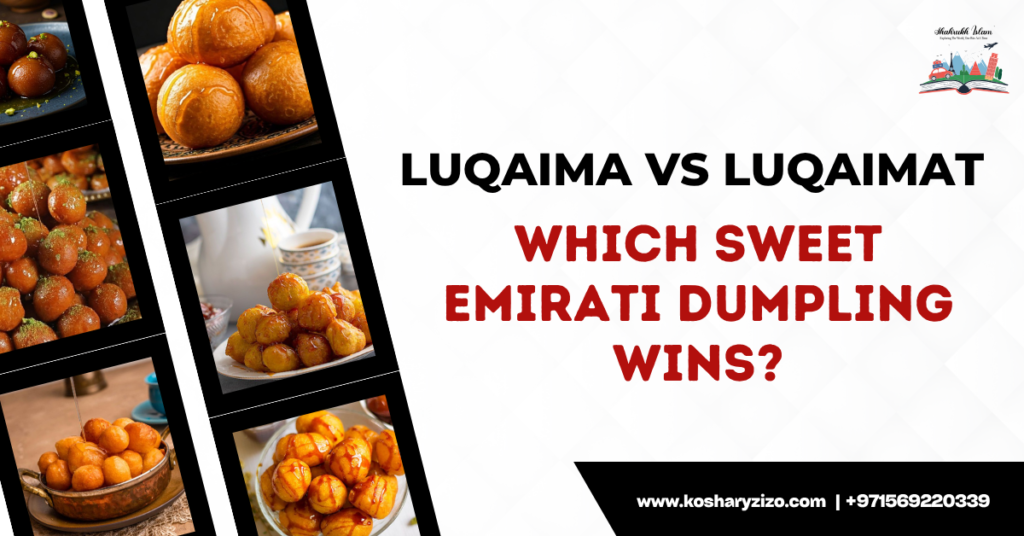
Luqaimat tends to be slightly larger, airier, and crispier. Think of it as the fried doughnut ball with a delicate crunch, followed by a soft, fluffy inside. When it is done properly, it literally melts in your mouth.
Luqaima, on the other hand, leans more toward chewy. It’s denser, often smaller, and feels more like a mochi-meets-beignet hybrid. There’s bounce to it. It’s not trying to be fancy—it’s trying to fill you up.
So if you’re into pillowy, light bites that vanish in a sugar cloud? Luqaimat’s your girl. But if you want something that feels substantial, go for Luqaima.
2. Flavour Profile: It’s All in the Syrup (and Spices)
Both dumplings are sweet. Like, dangerously sweet.
But Luqaimat usually has a little more character: cardamom, saffron, sometimes a pinch of turmeric…the syrup might be date-based, honeyed, or glazed with dibs (date molasses).
Luqaima, by contrast, is often simpler. More straightforward in taste, letting the deep-fried dough be the star. Some places even skip the spices altogether and focus on texture + golden crunch.
I had Luqaima at a roadside stall in Ajman once that was so clean and minimal—just crispy dough and sticky sugar—it felt like dessert stripped down to its bare essence. And I weirdly loved it.
3. Cultural Identity: Where You’re From Matters
Here’s where it gets interesting. Luqaimat is the term most often used in the UAE. This is the name you will hear during Ramadan, the name that you will find during heritage festivals, and the name the grandma insists taste better “the way it used to be.” In the other Gulf countries – Oman, Bahrain, Saudi Arabia – you will find the name Luqaima to be more popular. Even within the UAE, you will hear both names depending on the emirate you are in, who your family is or what mood you are in. It is similar to how Canadians and Americans both love Timbits but will fight about which is better (chocolate-glazed or sour cream). So yes, technically, these are regional variations. But nothing wrong with preferring 1. Or loving both. Or arguing about it for hours with your cousins. That’s the fun part.
4. How They’re Served: Tradition vs. Trend
Let’s talk toppings.
Luqaimat has become the Insta-darling. Cafés drizzle them with everything from Nutella to crushed pistachios to gold flakes. (Yes. Real gold.)
Luqaima, on the other hand, tends to stay OG. Minimal syrup. Maybe a dusting of sesame. No frills, no filters.
If you’re ordering online (like from KosharyZizo.com), you’ll likely get both traditional and modern twists. But honestly? Go traditional at least once. It hits different.
5. Pronunciation Drama: Just Say It With Your Chest
Okay, real talk?
Luqaimat is technically the plural of Luqaima. So one is a dumpling, the other is a bunch of dumplings.
That’s right. We’ve been fighting over semantics.
In Arabic:
- Luqaima = “little bite”
- Luqaimat = “little bites”
So when someone says, “Let’s grab Luqaima,” they’re not wrong. They’re just maybe… grammatically minimal?
Bottom line? Say what feels right. Eat what tastes better.
CLEAN CONCLUSION: So… Who Wins?
Thanks for keeping it real here, buddy: they’re both satisfying. If you want your outsides crispy, your insides fluffy, and a flavour bomb, then luqaimat will be your sweet soulmate. If you want something denser, chewy, and just considered sweet, then luqaima will take you sweetly into her syrupy arms. You won’t lose either way. You’re just figuring out which side of the sweet Emirati dumpling spectrum you prefer. Or from making it yourself, eating from a dip ‘n’ go snack stall, or ordering online from KosharyZizo.com (seriously, do it, thank me later), you are part of a celebratory dessert tradition enjoyed across generations, languages, and continents of love. Just remember napkins. Because syrup is sticky, and everywhere.